Environmental Filtering Weakens with Trophic Level in Urban Coastal Ecosystems
Wenqian Xu, Yu-De Pei, Taylor M. W. Li, Joshua Bennett-Williams, Ruixian Sun, Shara K. K. Leung, Masayuki Ushio, Alex S. J. Wyatt*, Charmaine C. M. Yung*
Department of Ocean Science, The Hong Kong University of Science and Technology, Kowloon, Hong Kong
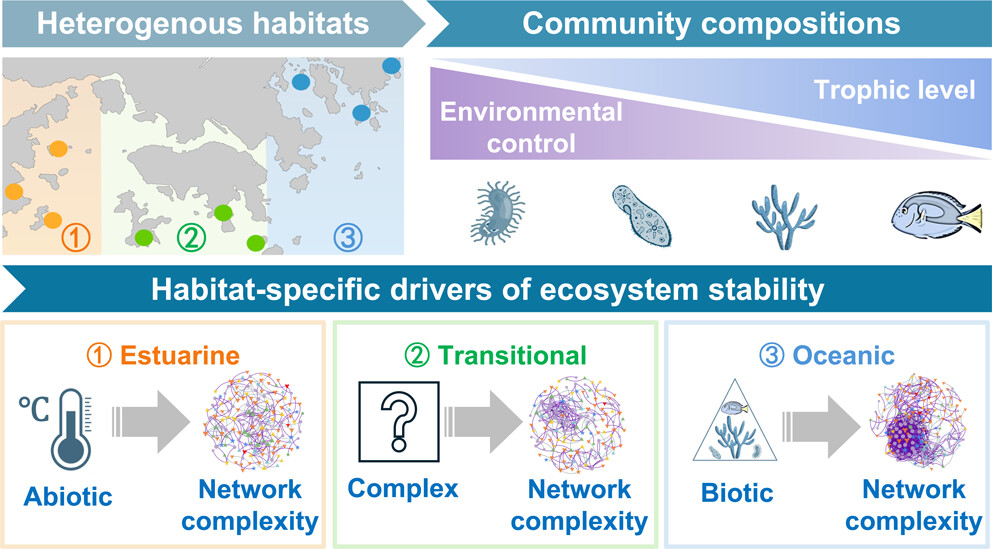
Urban coastal ecosystems face increasing anthropogenic pressures and environmental variability, yet the consequences for multitrophic biodiversity and ecosystem networks remain poorly resolved. Here, we combine environmental DNA metabarcoding, visual surveys, flow cytometry, and environmental measurements to examine the spatiotemporal dynamics of marine metazoans, protists, and prokaryotes across estuarine, transitional, and oceanic habitats in Hong Kong’s urbanized coastal waters. Using permutational multivariate analysis of variance (PERMANOVA), we demonstrate that environmental control over community composition weakens systematically at higher trophic levels. The variance explained by seasonal and spatial interaction was highest for prokaryotes (R2 = 0.76) and protists (0.59), but notably lower for benthic fauna (0.41) and bony fish (0.32). Co-occurrence network analysis revealed that oceanic habitats, dominated by heterotrophic prokaryotes, omnivorous fish, and hard corals, supported the most complex and stable multitrophic networks, with an average complexity of 0.54 compared to estuarine (0.23) and transitional habitats (0.29). Structural equation modeling further revealed habitat-specific drivers: temperature exerted the strongest direct effect in estuarine habitats (>0.44), while biotic interactions involving primary producers played a dominant role in oceanic habitats (direct effect >0.28). In contrast, transitional habitats lacked significant environmental or biotic drivers, indicating a system in flux where community dynamics are likely governed by complex variables beyond standard environmental or biotic regulation. These findings demonstrate the gradient-dependent interplay of environmental filtering and biotic regulation in shaping coastal ecosystem stability. Our results also highlight the value of an integrated eDNA-based framework for monitoring biodiversity and ecosystem change, providing insights for the management of urban marine environments under global change.